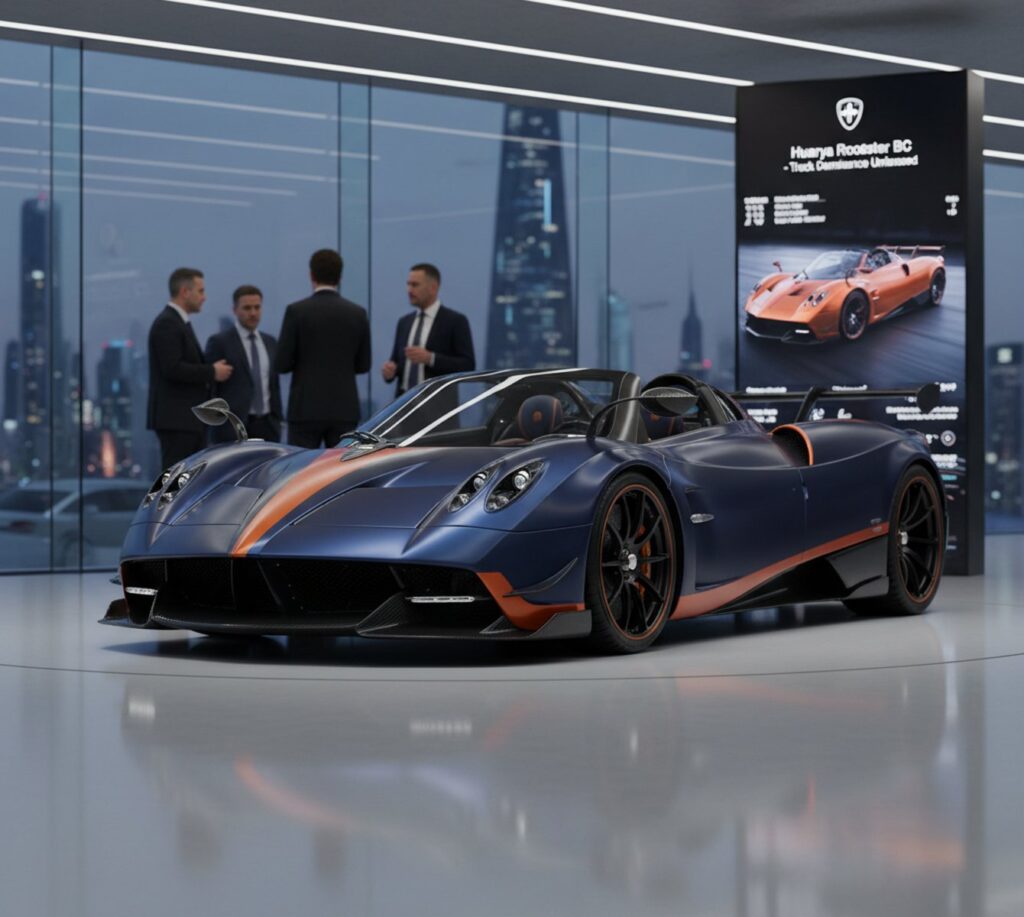
2026 Pagani Huayra Roadster BC Unveiled: Radical Open-Air Performance, Extreme Aero-Sculpting, and The Secrets Behind its Track Dominance
In the rarefied air where automotive engineering becomes high art, Pagani Automobili operates on a plane of its own. The unveiling of the Huayra Roadster BC is not merely the launch of a new model; it is a declaration of dominance. This is Horacio Pagani’s ultimate open-top statement, a machine that meticulously blends brutal, track-honed performance with a sculptural beauty that defies convention. It’s an evolution, not just a derivative, pushing the very definition of what a roadster can be.
From every angle, the Roadster BC is a study in functional aggression. Its form is dictated entirely by airflow, a symphony of swooping lines, deep channels, and active aerodynamic components. The new bodywork, crafted from an advanced composite of Carbon-Titanium HP62 G2 and Carbon-Triax HP62, is both lighter and structurally stiffer than its predecessors. A colossal rear wing works in concert with four independently-managed flaps, generating an astonishing 500 kg (1,102 lbs) of downforce at 280 km/h (174 mph), pinning the car to the asphalt with relentless intent. The interior is a familiar Pagani sanctuary—a bespoke cockpit of machined aluminum, exposed carbon, and supple leather, where the signature exposed gear linkage remains a tactile centerpiece.
At its heart lies a bespoke Mercedes-AMG 6.0-liter twin-turbocharged V12, an engine developed exclusively for Pagani. For the Roadster BC, output has been elevated to a staggering 802 horsepower and 774 lb-ft of torque. This monumental power is channeled through a lightweight, single-clutch Xtrac 7-speed transversal automated manual transmission, chosen specifically for its rapid shift times and significant weight savings over a dual-clutch unit. The carbo-titanium monocoque provides a foundation of immense rigidity, allowing the electronically controlled, active suspension to manage forces with surgical precision.
While built for the circuit, the cabin remains an exquisitely tailored environment. The experience is visceral and driver-focused, from the satisfying mechanical click of the switchgear to the deep bucket seats that hold you fast. There is no oversized infotainment screen to distract; the primary interface is the road itself, communicated through the perfectly weighted steering and the chassis. Every element, from the milled pedals to the instrument cluster, is a piece of mechanical jewelry designed to heighten the sensory experience of driving at the limit.


In a market of serialized supercars, the Huayra Roadster BC stands apart as a coachbuilt masterpiece. Limited to a mere 40 examples worldwide, it competes less with contemporaries from Ferrari or Lamborghini and more with its own legend. For the discerning U.S. buyer, it represents the absolute zenith of Italian hypercar philosophy—an investment in kinetic art that offers an unmatched level of personalization and a driving experience that is as emotionally resonant as it is physically demanding. This is not a car you simply own; you commission it.
The Roadster BC’s most profound innovations are woven into its very structure. The active aerodynamic system is its nerve center, constantly adjusting pitch, roll, and aerodynamic balance in real-time. This system works in tandem with specially developed Pirelli PZero Trofeo R tires to deliver unprecedented mechanical and aerodynamic grip. The engineering marvel, however, is achieving a dry weight of just 1,250 kg (2,756 lbs)—lighter than the BC coupe—while simultaneously increasing torsional and flexural rigidity, a feat that defies conventional automotive engineering principles for convertibles.
Our expert analysis reveals a crucial insight: the Roadster BC is not a compromised, roofless version of the coupe. It is a superior machine in many respects. By removing the roof and re-engineering the chassis from the ground up, Pagani has created a more immersive, multi-sensory experience without sacrificing an ounce of performance. Hearing the unfiltered roar of the AMG V12 and the whistle of the turbos just inches behind your head is a primal thrill that no coupe can replicate. It’s a track weapon with an infinitely high ceiling, delivering an unfiltered connection between driver, machine, and the elements.
Ultimately, the Pagani Huayra Roadster BC is a triumph of vision and execution. It solidifies Horacio Pagani’s legacy as a modern-day da Vinci of the automotive world, proving that extreme performance and breathtaking beauty are not mutually exclusive. For the 40 fortunate individuals who will take ownership, it represents more than just a car; it’s a rolling sculpture, a technical marvel, and arguably the most emotionally charged open-top driving experience ever conceived.


Frequently Asked Questions (FAQ)
1. How does the Roadster BC’s performance compare to the standard Huayra Roadster?
The Roadster BC is a significant step up. It boasts 802 hp compared to the standard 754 hp, features a completely new active aerodynamics package that generates substantially more downforce, and is lighter thanks to advanced carbon-titanium composites. It is a far more aggressive, track-focused machine.
2. Is the Pagani Huayra Roadster BC street-legal in the United States?
Yes, the Huayra Roadster BC was engineered to be fully federalized and is street-legal in the United States. Despite its track-ready credentials, it meets all necessary U.S. safety and emissions standards, distinguishing it from many track-only hypercars.

3. What was the original price and current availability of the Huayra Roadster BC?
The original manufacturer’s suggested retail price was approximately $3.5 million USD before personalization options. With a production run of only 40 units globally, all were sold out to select Pagani clients long before the public unveiling. They now trade on the secondary market for significantly higher figures.
4. What makes the “Carbo-Titanium HP62 G2” material so special?
This proprietary composite material, developed by Pagani, weaves titanium strands directly into the carbon fiber fabric. This process creates a material that is not only lighter than traditional carbon fiber but also significantly stronger and more resistant to fracture, providing Formula 1-levels of chassis rigidity and crash protection.

Share this article
Help other drivers discover this story.