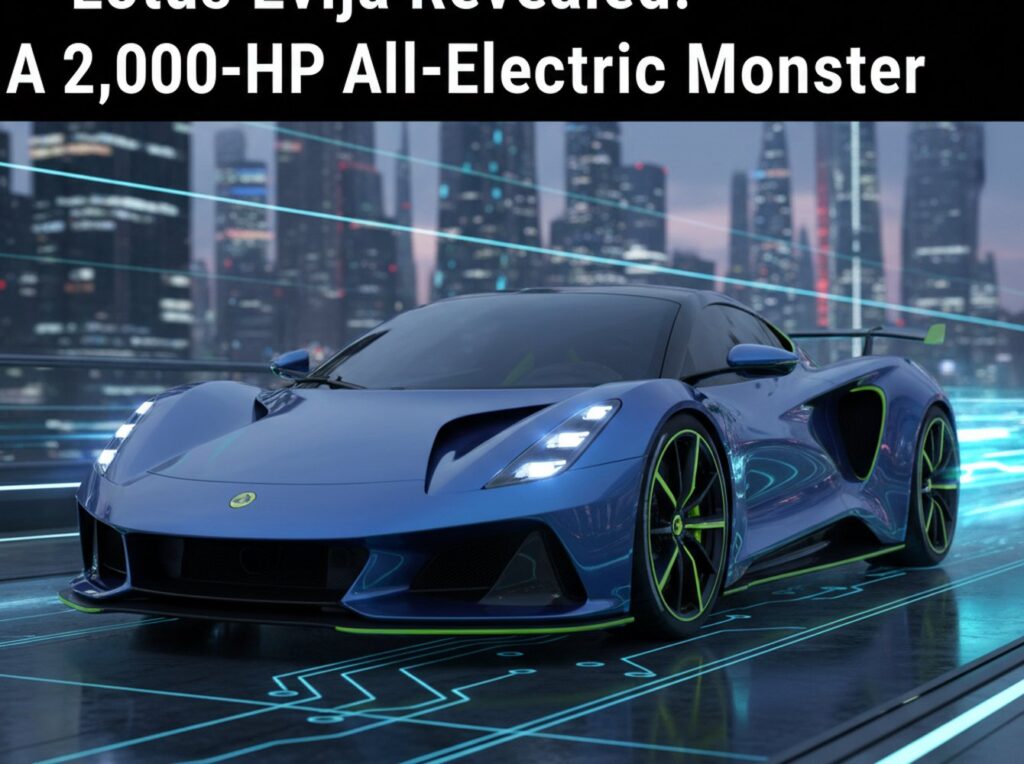
Lotus Evija Revealed: A 2,000-HP All-Electric Monster
Lotus has officially pulled the covers off the 2026 Evija, a machine that redefines the very essence of the hypercar. This all-electric powerhouse is not merely the brand’s new flagship; it is a profound statement of intent, demonstrating that the future of extreme performance is electric. The Evija channels the company’s legendary focus on chassis dynamics and lightweight engineering into a new era, promising an experience that is both technologically groundbreaking and quintessentially Lotus.
A Modern Touch to a Classic Design
The Evija’s exterior is a masterclass in aerodynamic efficiency, guided by a principle Lotus calls “porosity.” The body appears carved by wind, featuring two massive Venturi tunnels that run through the rear haunches. These are not just stylistic flourishes; they actively manage airflow to generate immense downforce without the need for oversized wings, creating a clean, dramatic silhouette. The entire chassis is a single-piece carbon fiber monocoque, weighing a mere 284 pounds, ensuring maximum rigidity and safety while adhering to Lotus’s obsession with minimizing mass.
Built for Strength and Adventure


At the heart of the Evija lies one of the most powerful automotive powertrains ever created. Four individual electric motors—one at each wheel—are supplied by a mid-mounted 70 kWh battery pack, co-developed with Williams Advanced Engineering. The combined output is a staggering target of 1,973 horsepower (2,000 PS) and 1,254 lb-ft of torque. This enables breathtaking acceleration, with 0-62 mph projected in under three seconds, and a top speed exceeding 200 mph. True all-wheel-drive torque vectoring allows for instantaneous and precise power distribution, promising unprecedented cornering capabilities.
Comfort Meets Utility
Inside, the Evija’s cabin is a minimalist, driver-focused environment. The floating “ski slope” center console houses haptic feedback buttons, while all critical information is displayed on a state-of-the-art digital screen. The Formula 1-inspired steering wheel contains all essential controls, from drive mode selection to turn signals, allowing the driver’s hands to remain on the wheel. Despite its track-focused nature, the interior is finished with exquisite materials like carbon fiber and Alcantara, offering a tailored, premium feel for its occupants.
Why It Stands Out


In a market now seeing the emergence of electric hypercars like the Rimac Nevera and Pininfarina Battista, the Evija stands apart with the Lotus heritage. While competitors focus on outright straight-line speed, Lotus has poured decades of chassis tuning expertise into the Evija to ensure it delivers the feedback, agility, and driver connection the brand is famous for. For U.S. buyers, it represents a unique opportunity to own a piece of automotive history—Britain’s first electric hypercar from a marque synonymous with pure driving pleasure.
Advanced Technology & Innovations
The Evija’s technology extends far beyond its powertrain. It is the world’s first production car to use laser headlights for both main and dipped beams. The battery system is engineered for ultra-fast charging, capable of accepting an 800kW charge, which, though not yet commercially available, would fully replenish the battery in nine minutes. With current 350kW charging technology, an 80% charge can be achieved in just 18 minutes, setting a new benchmark for EV performance cars.

Expert Analysis / Unique Perspective
What makes the Evija truly compelling is its mission to translate the analogue soul of a Lotus into a digital masterpiece. It forgoes the roar of a combustion engine for the instant, relentless thrust of electricity. The challenge—and the achievement—has been to engineer feel and feedback into a system governed by algorithms. The active aerodynamics and granular torque vectoring aren’t just for raw speed; they are tools to make a 3,700-pound car handle with the deftness of a vehicle half its weight, a core tenet of the Lotus philosophy.

Final Thoughts
The 2026 Lotus Evija is a watershed moment. It is a bold, uncompromising vision of the future that honors the past. By combining a revolutionary electric powertrain with its legendary chassis expertise, Lotus has created not just a competitor, but a potential leader in the electric hypercar space. Limited to just 130 units worldwide, it is destined to become an icon of this electric performance revolution.
Frequently Asked Questions (FAQ)
What is the official driving range of the 2026 Lotus Evija?
Lotus is targeting a range of approximately 250 miles on the WLTP combined cycle. However, as with any hypercar, aggressive track driving or sustained high-performance use will significantly reduce this figure.
How does the Evija’s weight compare to other hypercars?
At a target weight of 1,680 kg (around 3,700 lbs), the Evija is exceptionally light for a 2,000-hp all-electric vehicle. While heavier than its internal combustion counterparts, its extensive use of carbon fiber makes it one of the lightest EVs of its kind.
Is the Evija’s battery technology future-proof?
The Evija’s battery and charging system, developed with Williams Advanced Engineering, is designed to be among the most advanced on the market. Its ability to accept an 800kW charge prepares it for the next generation of charging infrastructure, making it a forward-thinking investment.
How many Lotus Evijas will be produced?
Production is strictly limited to a maximum of 130 units globally. This extreme rarity ensures its exclusivity and solidifies its status as a highly sought-after collector’s vehicle.
Share this article
Help other drivers discover this story.