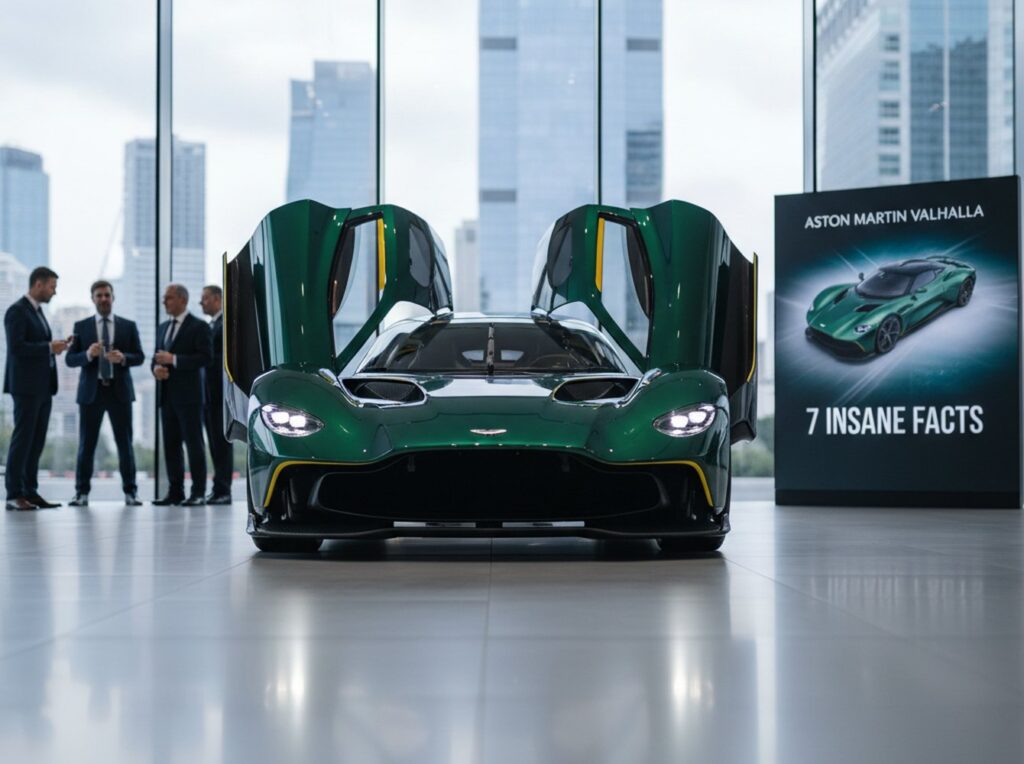
7 Insane Facts About the New $800k Aston Martin Valhalla
Aston Martin has officially pulled the covers off the 2026 Valhalla, a vehicle that fundamentally redefines the brand’s performance trajectory. Positioned as a direct descendant of the Valkyrie hypercar, the Valhalla translates extreme Formula 1 technology into Aston Martin’s first series-production, mid-engine supercar, charting a bold new course for the British marque.
The Valhalla’s design is a masterclass in aerodynamic purpose, heavily influenced by its Valkyrie sibling. Every surface, from the aggressive front splitter to the active multi-element rear wing and massive underbody diffuser, is sculpted by airflow to generate over 1,300 lbs of downforce. Built around a bespoke carbon fiber monocoque, the structure provides immense rigidity and a lightweight foundation. Inside, the cockpit is a driver-focused environment, eschewing clutter for a minimalist layout with premium Alcantara and exposed carbon fiber, ensuring every control is perfectly placed for high-performance driving.
At its heart is a revolutionary hybrid powertrain engineered for uncompromising performance. A bespoke 4.0-liter twin-turbo flat-plane crank V8 engine screams to 7,200 rpm, working in concert with three electric motors. Two motors on the front axle provide intelligent all-wheel-drive and torque vectoring, while a third is integrated into the new 8-speed dual-clutch transmission. This combined system unleashes a staggering 1,012 PS (approximately 1,000 horsepower), targeting a 0-62 mph sprint of just 2.5 seconds and a top speed exceeding 217 mph.
Despite its track-honed credentials, the Valhalla incorporates concessions for real-world usability. The cabin offers more space and easier entry than a pure hypercar, while the infotainment system is centered around a streamlined touchscreen with essential connectivity. The driver interface is purposefully minimalist, with a digital gauge cluster that prioritizes critical data like gear selection, engine speed, and performance modes, allowing for maximum focus on the road or track.


Entering a fiercely contested segment, the Valhalla stands apart as a distinct British contender against rivals like the Ferrari SF90 Stradale. While its competitors offer their own unique character, the Valhalla’s unique selling proposition is its direct lineage to motorsport, particularly its F1-inspired chassis dynamics and aerodynamic philosophy. For U.S. buyers, it represents a new and compelling alternative, blending cutting-edge hybrid tech with Aston Martin’s signature elegance.
The Valhalla’s technology is its core strength. The advanced plug-in hybrid system enables a 10-mile EV-only mode for silent urban travel, while its ‘e-reverse’ feature cleverly uses the electric motors for reversing, eliminating the weight and complexity of a traditional reverse gear in the transmission. The car’s most impressive innovation is its active aerodynamics, which work with the push-rod suspension to create a stable, confidence-inspiring platform at extreme speeds without the need for crude, oversized wings.
From an expert perspective, the Valhalla is more than just a new model; it’s a statement of intent from Aston Martin. It successfully democratizes the esoteric technologies of the Valkyrie, proving the brand can execute a world-class hybrid supercar that is both technologically advanced and emotionally resonant. It is engineered not just for raw numbers, but for a sublime and engaging driving experience that rewards sharm without being overly punishing.
Ultimately, the 2026 Aston Martin Valhalla is a landmark achievement. It masterfully bridges the gap between the brand’s grand touring heritage and a new era of electrified, mid-engine performance. This is the car that will define Aston Martin for the next decade, setting the stage for a new generation of vehicles that blend immense power with sophisticated engineering.


Frequently Asked Questions (FAQ)
1. How does the Valhalla’s hybrid system differ from its competitors?
The Valhalla’s system is deeply rooted in Formula 1 principles, particularly its focus on lightweighting and aerodynamic integration. It uses three motors for precise torque vectoring and eliminates a traditional reverse gear to save weight, showcasing a motorsport-derived approach to efficiency and performance.
2. Is the 2026 Aston Martin Valhalla a practical daily driver?
While it is designed with more cabin space and comfort than a pure hypercar like the Valkyrie, the Valhalla is fundamentally a track-focused supercar. It is not intended for daily commuting but is engineered to be more manageable and usable on public roads than its extreme sibling.

3. What is the official price and availability of the Valhalla?
The Aston Martin Valhalla is expected to start at approximately $800,000 USD. Production will be a limited series, making it a highly exclusive vehicle with deliveries scheduled to begin for the 2026 model year.
4. What are the key performance targets for the Valhalla?
The primary targets are a combined output of over 1,000 horsepower, a 0-62 mph (100 km/h) time of 2.5 seconds, and a top speed of over 217 mph (350 km/h). It also aims for a Nürburgring lap time under 6 minutes and 30 seconds.

Share this article
Help other drivers discover this story.