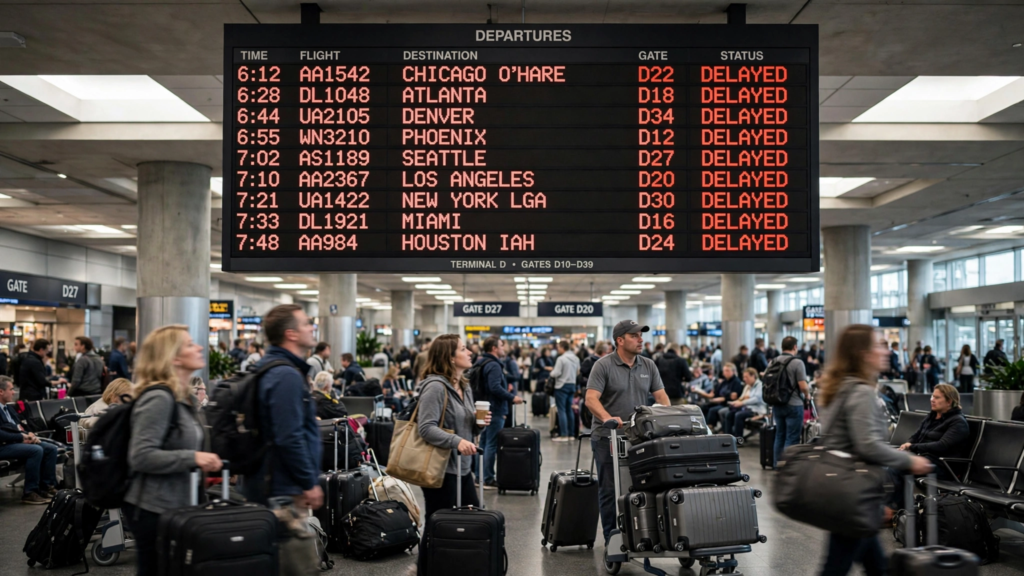
3,621 US Flights Delayed Today — What Stranded Passengers Should Do and What You’re Owed
More than 3,600 U.S. flights were delayed and 169 were canceled on Friday, Oct. 3, 2026, as the national air system continued to reel from severe thunderstorms that hit North Texas the day before. The disruptions stranded an estimated 400,000 passengers and triggered cascading delays from Dallas to Chicago, Boston and San Francisco.
If you are flying today, the most useful question is not how big the number is — it’s what you should do right now and what you are legally owed.
What Happened?
According to FAA air traffic reports and flight tracking data, a series of thunderstorm cells and equipment issues forced the FAA to issue ground stops and then ground delay programs for Dallas-Fort Worth International Airport (DFW) and Dallas Love Field (DAL) on Oct. 2. FlightAware data cited by local outlets showed more than 1,300 cancellations at DFW on Thursday afternoon, with average delays exceeding 2 hours and maximum delays over 10 hours.


Because DFW is American Airlines’ largest hub, aircraft and crews were left out of position. On Oct. 3, the FAA continued ground delay programs at DFW, Chicago O’Hare (ORD), San Francisco (SFO) and Boston Logan (BOS). Average arrival delays were 60-75 minutes at DFW, 45-60 minutes at ORD and SFO, and about 45 minutes at BOS.
Who Is Affected?
Today’s breakdown by airport:
- DFW: 389 delays, 27 cancellations — still the worst impacted
- Dallas Love Field: 90+ delays, 13 cancellations
- Chicago O’Hare: 290 delays, 23 cancellations
- Boston Logan: 247 delays, 6 cancellations
- San Francisco: 218 delays, 2 cancellations
- Miami, Atlanta, New York LaGuardia, Denver, Houston: 80-290 delays each from cascading aircraft shortages
American Airlines and its regional carriers Envoy Air and PSA bore the brunt at DFW. Southwest was hit hard at Love Field, United at O’Hare and SFO, and Delta through Atlanta. Any itinerary that connects through Texas or uses a plane that was supposed to come from Texas is at risk today.

What Should Stranded Passengers Do Now?
1. Check before you go. The FAA advises: always check with your airline app before leaving for the airport. Status can change quickly during a ground delay program.
2. Don’t accept a voucher if you want a refund. Under DOT rules that took effect in 2024 and remain in force in 2026, if your flight is canceled for any reason or significantly delayed and you choose not to travel, you are entitled to a full cash refund to your original payment method — not a voucher. For domestic flights, DOT guidance points to 3+ hours as a significant delay.

3. Ask for free rebooking. Airlines must rebook you on the next available flight at no extra cost for cancellations and significant delays, even when the cause is weather.
4. Document everything. Save screenshots of delay notices, boarding passes and receipts for meals, hotels and alternative transport. If the delay is later classified as controllable (crew, mechanical), you may need them for reimbursement claims.

Are You Owed Compensation?
U.S. law is different from EU law. Airlines are NOT required to pay fixed cash compensation for weather delays. They are required to provide:
- Automatic cash refunds if you decline to travel after cancellation or significant delay
- Refund of unused ancillary fees (bags, seat upgrades)
- For controllable delays (airline staffing, mechanical), DOT expects meals for 3+ hour delays and lodging for overnight delays, but airlines set their own customer service plans
A DOT proposal from November 2025 that would have mandated $200-$775 cash for controllable delays was withdrawn. So the core protection today is the refund right plus rebooking. File a complaint at airconsumerprotection.dot.gov if an airline refuses.
What Happens Next?
The best-case forecast is that the system normalizes by the evening of Oct. 3 and reaches 80% normal operations on Oct. 4 as aircraft and crews reposition. The worst case is additional Texas storms triggering more FAA programs and 500-1,000 delays continuing into Oct. 4. Most analysts expect gradual improvement through Oct. 5.
Check the FAA Air Traffic Control System Command Center advisories and your airline’s app for real-time ground delay information.
Sources
Share this article
Help other drivers discover this story.