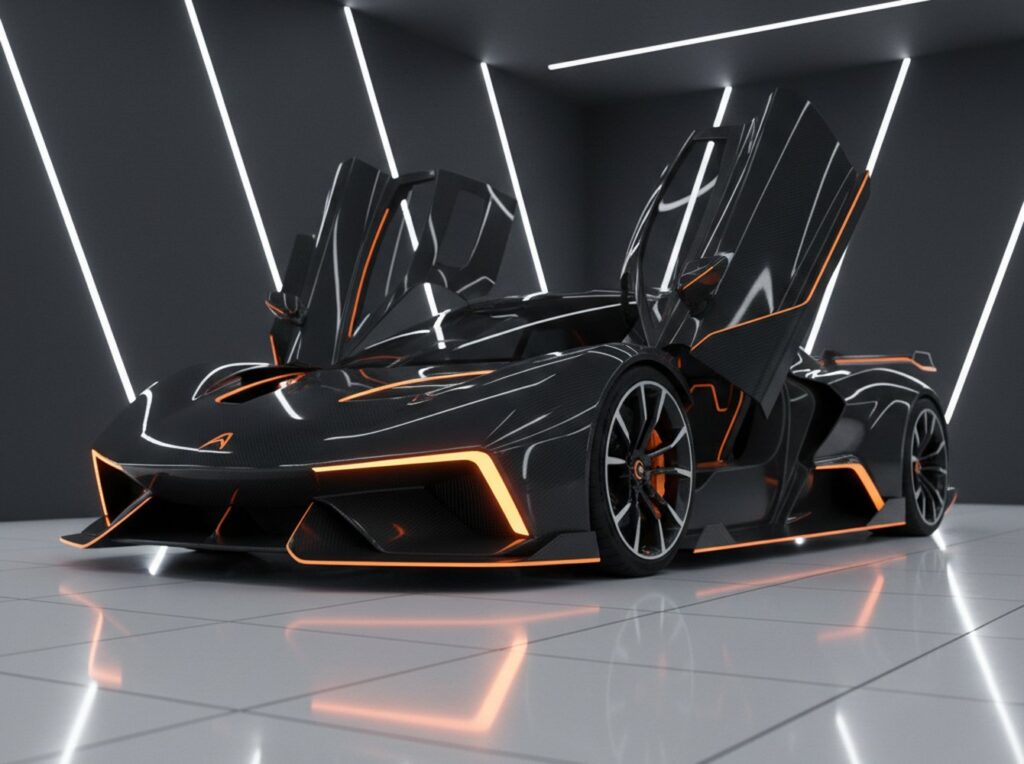
Aspark Owl: The New $3.1M King of Acceleration?
Aspark has officially pulled the wraps off the 2026 Owl, a machine that redefines the outer limits of electric hypercar performance. This isn’t just an update; it’s an audacious statement of power, cementing the Owl’s position as a titan of acceleration in an increasingly competitive field. It represents the brand’s unwavering commitment to pushing engineering boundaries for a very exclusive clientele.
A Modern Touch to a Classic Design
The Owl’s silhouette remains one of the most dramatic on the road, sitting at an astonishingly low 99 centimeters (39 inches) tall. For 2026, the full carbon fiber monocoque and body panels are refined for even greater aerodynamic efficiency. An active rear wing deploys at speed to generate significant downforce, while subtle revisions to the front splitter and underbody channels manage airflow with surgical precision. The interior remains a minimalist, driver-focused cockpit, now with enhanced carbon detailing and bespoke switchgear.
Built for Strength and Adventure


At the heart of the Owl are four potent permanent magnet synchronous motors, delivering a combined output of 1,984 horsepower and approximately 1,475 lb-ft of torque. This immense power, channeled through a sophisticated torque-vectoring system, enables a claimed 0-60 mph time of 1.69 seconds. The 69 kWh battery pack is engineered for maximum power discharge rather than outright range, a clear indication of its track-focused purpose. Carbon-ceramic brakes provide the necessary stopping force for a vehicle capable of a 249 mph top speed.
Comfort Meets Utility
Practicality is not the Owl’s primary mission. The cabin is a snug, form-fitting environment designed to connect the driver directly to the chassis. Twin digital screens provide critical performance data, eschewing complex infotainment for pure functional clarity. Getting in and out of the butterfly doors requires dexterity, reinforcing that this is a special-occasion vehicle. The focus is on the raw, unadulterated driving experience, not grand touring comfort.
Why It Stands Out


In a market occupied by titans like the Rimac Nevera and Pininfarina Battista, the Aspark Owl carves its niche through sheer extremity. While competitors balance hyper-performance with a degree of luxury, the Owl is a more singular weapon, obsessed with acceleration and a low-slung aesthetic. For U.S. buyers and collectors, it represents an opportunity to own one of the most exclusive and talked-about vehicles on the planet—a true conversation piece backed by world-beating numbers.
Advanced Technology & Innovations
The Owl’s true genius lies in its software and power management. The proprietary system controlling the four motors makes thousands of adjustments per second to ensure stability and traction under forces that would overwhelm conventional systems. The battery’s unique chemistry allows for rapid, sustained power delivery necessary for its record-breaking acceleration runs. This is less a car and more a rolling laboratory for next-generation electric propulsion.

Expert Analysis / Unique Perspective
The Aspark Owl is a brilliant, if slightly mad, engineering exercise. It answers a question few thought to ask: how fast can an electric car accelerate? It lacks the brand heritage of a Bugatti or the polished duality of a Rimac, but it compensates with an unapologetic and singular focus. Its value is derived not from history, but from its audacious, record-shattering present.

Final Thoughts
The 2026 Aspark Owl is more than just a hypercar; it is a monument to the explosive potential of electric power. It solidifies Aspark’s reputation as a fearless innovator in the automotive world. While its production numbers will remain incredibly low, its impact on the industry and the benchmarks it sets will be felt for years to come, proving that the future of performance is not just fast, but violently, breathtakingly quick.
Frequently Asked Questions
1. How does the 2026 Aspark Owl’s acceleration compare to a Rimac Nevera?
Both cars are in the sub-two-second 0-60 mph club. The Aspark Owl is singularly focused on achieving the lowest possible time, often claimed at 1.69 seconds, making it a specialist in pure straight-line bursts. The Rimac Nevera, while phenomenally quick, is engineered as a more well-rounded hyper-GT, balancing its record-breaking speed with superior handling dynamics and comfort.
2. Is the Aspark Owl a practical car for daily driving?
Absolutely not. With its extremely low ride height, limited ground clearance, spartan interior, and minimal storage, the Owl is a purpose-built machine for track days, car shows, and special events. It is an experience, not a mode of transportation.
3. What is the real-world range of its 69 kWh battery?
While the official NEDC cycle claims a range of up to 280 miles, this is not representative of real-world use. The battery is optimized for massive power output. With the kind of aggressive driving the car encourages, owners should expect a realistic range closer to 150-180 miles per charge.
4. With a $3.1 million price, who is the target buyer?
The target buyer is an elite hypercar collector or technology enthusiast who values extreme, record-breaking performance and exclusivity above all else. They are likely to own several other high-performance vehicles and are purchasing the Owl for its status as one of the fastest-accelerating cars ever made.
Share this article
Help other drivers discover this story.