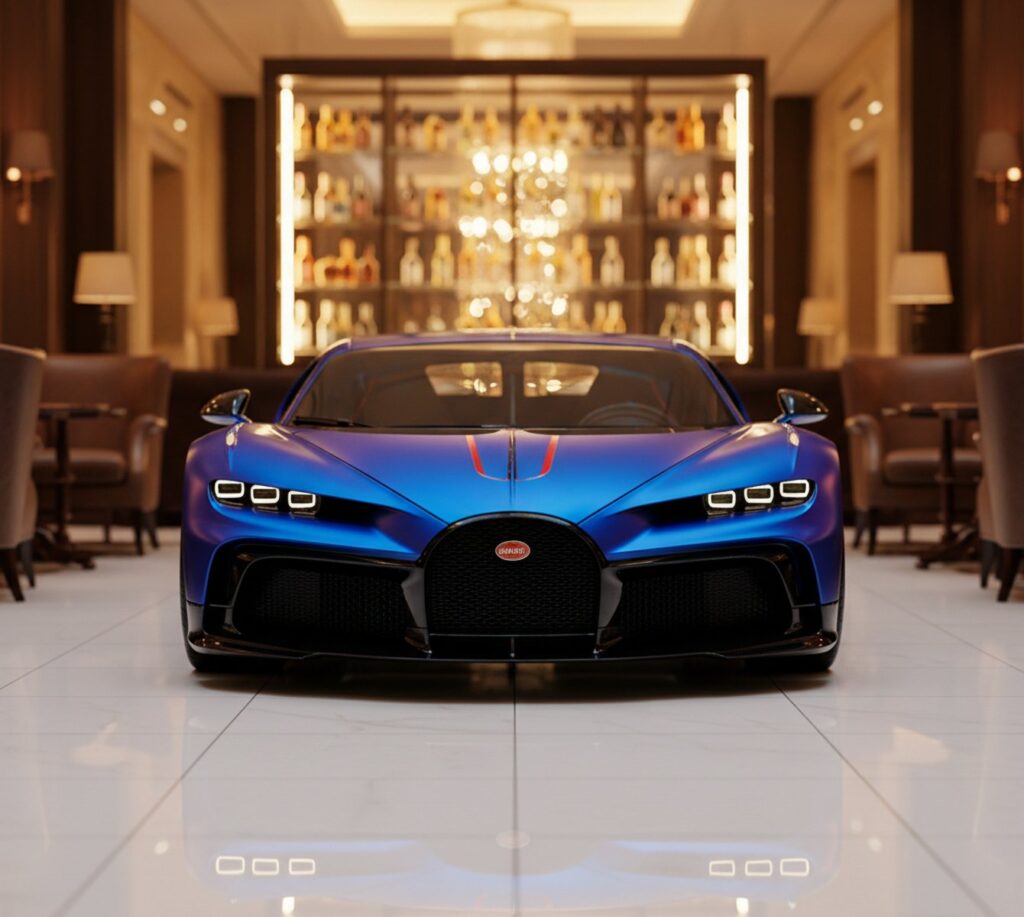
How the Bugatti Divo Achieved Radical Agility
Bugatti has long been the undisputed sovereign of straight-line velocity, a titan of terminal speed. With the Divo, however, the Molsheim atelier has executed a brilliant and aggressive pivot. This is not another chapter in the pursuit of V-max; it is a masterclass in dynamic prowess, a hypercar painstakingly engineered not for the salt flats, but for the apexes of the world’s most demanding circuits. The Divo is Bugatti’s declaration that absolute power can, and should, learn to dance.
At first glance, the Divo is a dramatic departure from its Chiron sibling. Every surface of its full carbon fiber body has been sculpted by the forces of air. The redesigned front fascia features wider air inlets and a formidable splitter that begins the process of managing airflow. The iconic Bugatti C-line is reinterpreted, wrapping tightly around a cabin finished in bespoke Divo Racing Blue Alcantara and exposed carbon. The true centerpiece, however, is the new rear architecture, featuring a towering 1.83-meter fixed wing and a complex 3D-printed taillight arrangement that creates a visual signature of raw purpose.
While the legendary 8.0-liter, quad-turbocharged W16 engine remains, producing its familiar 1,500 PS (1,479 horsepower), its application is entirely new. Engineers focused on sharpening responses, recalibrating the chassis and suspension for significantly increased camber and a firmer setup. The steering has been made more direct, providing unfiltered feedback from the road. The result is a car capable of generating an astounding 1.6 g of lateral acceleration—a figure that places it firmly in elite track-weapon territory.
Inside, the Divo trades some of the Chiron’s grand-touring opulence for a more purposeful, driver-centric environment. Asymmetrical color splits separate the driver and passenger zones, while extensive use of matte carbon fiber and Alcantara reduces glare and saves weight. Comfort is not sacrificed, but it is redefined; here, comfort is the confidence a driver feels when perfectly connected to the machine. Practicality is found not in luggage space, but in the sheer accessibility of its monumental performance.


In a market saturated with high-horsepower machines, the Divo carves its own niche. It isn’t a direct rival to the spartan, stripped-out track specials from McLaren or Ferrari. Instead, it offers a uniquely Bugatti proposition: the heart of a continental crusher fused with the reflexes of a corner-carving predator. For the U.S. collector, it represents the moment Bugatti looked beyond the horizon and embraced the hairpin turn, making it arguably the most desirable modern model from the French marque.
The Divo’s aerodynamic package is its technological tour de force. The massive rear wing, 23 percent wider than the Chiron’s retractable spoiler, generates a staggering 456 kilograms of downforce at top speed. This wing also functions as a highly effective air brake. A sophisticated NACA duct on the roof channels air to the engine bay, contributing to a complex thermal management system designed to withstand the immense heat generated during high-performance track driving. These are not cosmetic enhancements; they are fundamental engineering solutions to the challenge of making 1,500 horsepower turn.
Our analysis reveals a deeper truth: the Divo is a strategic masterstroke. It silenced the critique that modern Bugattis were one-dimensional. By limiting the top speed to 236 mph (380 km/h) due to the extreme downforce, the engineers made a deliberate choice to trade ultimate velocity for an entirely new dimension of driver engagement. This isn’t just a Chiron in a new suit; it’s a vehicle with a fundamentally different soul, proven by its 8-second lap time advantage over the Chiron at the Nardò handling circuit.
Ultimately, the Bugatti Divo stands as a monumental achievement. It is a testament to a brand willing to challenge its own identity and redefine its performance envelope. Limited to just 40 units, each already spoken for, the Divo is not merely a car but a pivotal moment in Bugatti’s history—a future icon that proves the king of speed can also be the master of the corner. It sets a new, thrilling precedent for what a Bugatti can be.


Frequently Asked Questions
1. Why is the Bugatti Divo’s top speed lower than the Chiron’s?
The Divo’s top speed is electronically limited to 236 mph (380 km/h) because of its high-downforce aerodynamic setup. The immense pressure generated by the fixed rear wing and aggressive bodywork, which is crucial for cornering grip, places extreme stress on the tires at higher speeds. It’s a deliberate trade-off: sacrificing top-end velocity for superior handling and agility.

2. Is the Divo a completely new car or based on the Chiron?
The Divo is a coachbuilt project based on the rolling chassis and powertrain of the Bugatti Chiron. However, it features entirely new exterior bodywork, a completely revised aerodynamic package, and significant tuning adjustments to its suspension, steering, and chassis to create a distinct handling-focused character.

3. How many Divos were made and what was the original price?
Production was strictly limited to 40 units worldwide. The net starting price was €5 million (approximately $5.8 million at the time of its announcement). All 40 examples were sold to existing Bugatti Chiron owners before the car was even publicly unveiled.
4. What makes the Divo’s handling so special compared to other Bugattis?
Its specialty lies in its focus on lateral acceleration and responsiveness. Engineers increased wheel camber, stiffened springs and anti-roll bars, and made the steering more direct. Combined with a 77-pound weight reduction and a massive 198 pounds of additional downforce, the Divo feels dramatically more agile and planted in corners than any Bugatti before it, allowing the driver to carry significantly more speed through turns.
Share this article
Help other drivers discover this story.