5 Wild Secrets of the Pagani Zonda HP Barchetta
In an era defined by electrification and digital interfaces, there exist artifacts that defy the relentless march of progress. They are not merely cars, but rolling monuments to a purer, more visceral form of automotive passion. The Pagani Zonda HP Barchetta is perhaps the most profound of these statements—a final, operatic crescendo for the Zonda lineage and a machine that represents the personal automotive id of its creator, Horacio Pagani.
A Masterclass in Bespoke Design
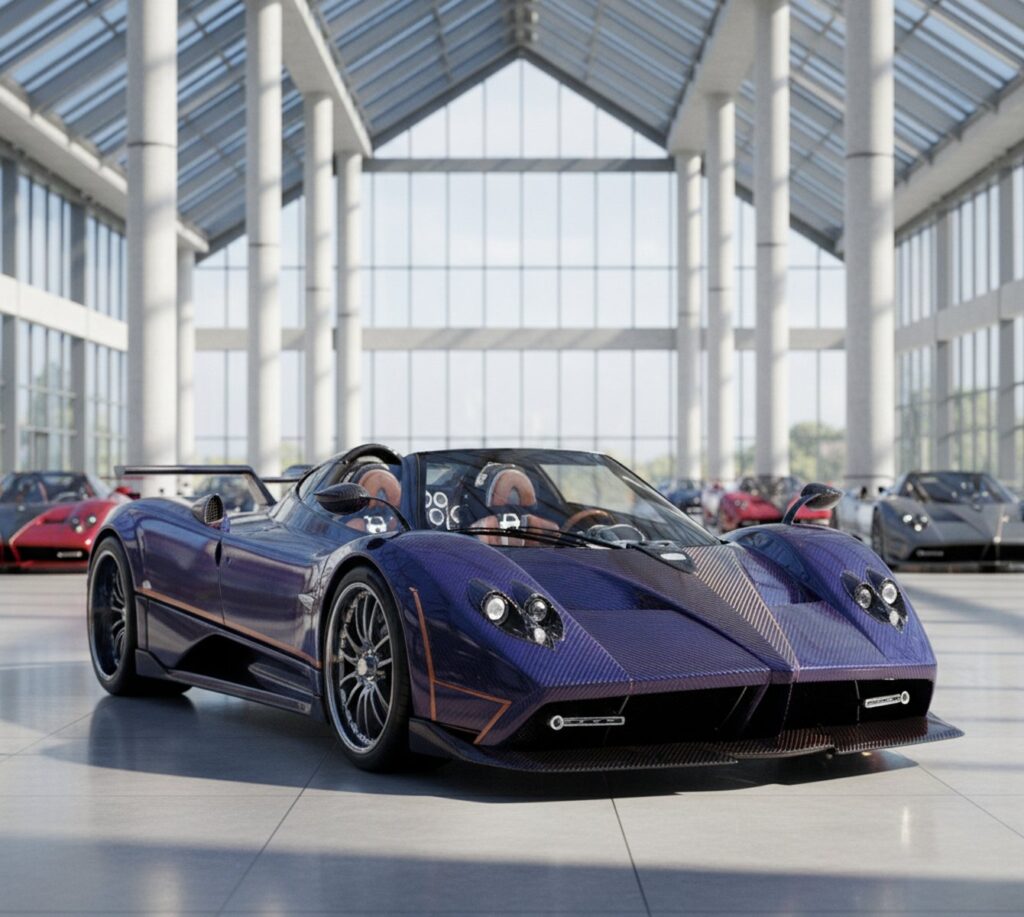
To call the HP Barchetta’s design a simple roadster would be a disservice. It is a true barchetta, an Italian term for a ‘little boat,’ defined by its complete lack of a roof and a dramatically chopped windscreen that flows seamlessly into the bodywork. The carbon fiber rear wheel spats, a clear nod to Group C racers of a bygone era, are as functional as they are theatrical, cleaning up airflow along the car’s flanks. Every inch of its body, rendered in Pagani’s proprietary Carbo-Triax HP52, is a testament to obsessive craftsmanship, with a blue-tinted carbon weave that shimmers under the light like a bespoke suit.
The Heart of the Beast: An Analog Soul


Nestled within the Carbo-Titanium monocoque is the soul of the machine: a Mercedes-AMG M120 7.3-liter naturally aspirated V12. Tuned to produce a formidable 789 horsepower and 627 lb-ft of torque, this engine is an acoustic masterpiece. Crucially, this immense power is channeled through a six-speed manual transmission. This deliberate choice forgoes milliseconds of shift time for an eternity of driver engagement, demanding sharm and rewarding precision. The chassis, despite its open-air configuration, exhibits extraordinary rigidity, while the race-derived pushrod suspension provides a level of feedback modern, electronically-dampened systems can only dream of.
An Interior of Unparalleled Artistry
The cabin is not a place of sterile technology but a sanctuary of mechanical art. The driver is met with analog dials, each a jewel of precision engineering, set into a dashboard of exposed carbon and supple leather. The iconic Pagani gear shifter, a sculpture of aluminum and carbon, remains the centerpiece. In a personal touch reflecting Mr. Pagani’s own tastes, the seats feature inserts of tartan fabric, an unexpected yet perfect flourish that connects this futuristic machine to classic automotive heritage. There is no infotainment screen to distract; the only interface that matters is the one between the driver, the controls, and the road.
A Class of One


To compare the HP Barchetta to its contemporaries is to miss the point. While hypercars like the Ferrari Monza SP1 or McLaren Elva explore similar open-cockpit concepts, the Pagani exists on a different plane of existence. With only three examples ever created—one for Horacio Pagani himself—it transcends the hypercar market, entering the realm of commissioned art. Its value is not derived from lap times but from its rarity, its manual gearbox, and its status as the ultimate expression of the legendary Zonda platform. For the U.S. collector, it represents one of the most exclusive and emotionally resonant vehicles on the planet.
The Science of Lightness and Strength
Pagani’s innovation has always been rooted in materials science, and the HP Barchetta is the pinnacle of that work. The monocoque utilizes a weave of Carbon-Titanium HP62 G2 and Carbo-Triax HP52, materials that offer greater stiffness and impact resistance than traditional carbon fiber at a lower weight. This obsessive focus on mass reduction results in a dry weight of just 2,756 pounds (1,250 kg), giving it a power-to-weight ratio that ensures its performance is as breathtaking as its aesthetics. The aerodynamic package is subtle yet effective, generating significant downforce without resorting to a massive, obstructive rear wing.

An Automotive Unicorn
From an expert’s perspective, the HP Barchetta’s greatest triumph is its unapologetic celebration of the analog experience. In a world chasing numbers, it chases feeling. The hydraulic steering communicates every nuance of the road surface, the naturally aspirated V12 delivers a linear, predictable surge of power, and the manual transmission provides a tactile connection lost in modern dual-clutch systems. It is, in essence, the physical manifestation of everything purists fear is disappearing from the automotive landscape. It is not a car for every day; it is a car for the perfect day.

The Final Word
The Zonda HP Barchetta is more than just the last Zonda; it is a closing statement on an era. It serves as a defiant benchmark for what a hypercar can be when stripped of all but the essential elements of speed, beauty, and emotion. It is Horacio Pagani’s personal vision brought to life, and its legacy will be measured not in performance figures, but in the enduring inspiration it provides to those who believe the soul of a car is its most important component.
Frequently Asked Questions
Q: What truly distinguishes the HP Barchetta from other special edition Zondas?
A: The HP Barchetta is unique due to its completely bespoke barchetta body style with no roof, a chopped windscreen, distinctive rear wheel spats, and power from the most potent evolution of the Zonda’s 7.3L naturally aspirated V12. Its extreme rarity—only three units, with one retained by the company’s founder—and manual transmission make it the definitive collector’s Zonda.
Q: Is the Pagani Zonda HP Barchetta street legal for use in the United States?
A: Due to its lack of a conventional roof and other non-standard features, the HP Barchetta does not meet federal road safety standards for mass sale. A U.S. owner would almost certainly need to import it under the stringent ‘Show or Display’ exemption, which limits road use to just 2,500 miles per year.
Q: Why did Pagani choose a manual transmission for such an advanced hypercar?
A: The choice was entirely philosophical. Horacio Pagani believes the most exclusive and driver-focused cars should offer the purest, most engaging experience possible. The manual gearbox was selected to create a raw, mechanical connection between driver and machine, prioritizing tactile feedback and involvement over the fraction-of-a-second advantage of a paddle-shift system.
Q: Given its rarity, what is the current estimated value of a Zonda HP Barchetta?
A: While the original reported price was approximately $17.5 million, its current value on the private market is speculative and likely far higher. As one of only three examples and representing the end of the Zonda’s official production, it is considered a ‘priceless’ piece of automotive art by top collectors, with any potential sale commanding a monumental premium.
Share this article
Help other drivers discover this story.